Eclipsing Putin?
The August eclipses, the Saturn–Neptune cycle and the possible end of Russia’s latest personal regime

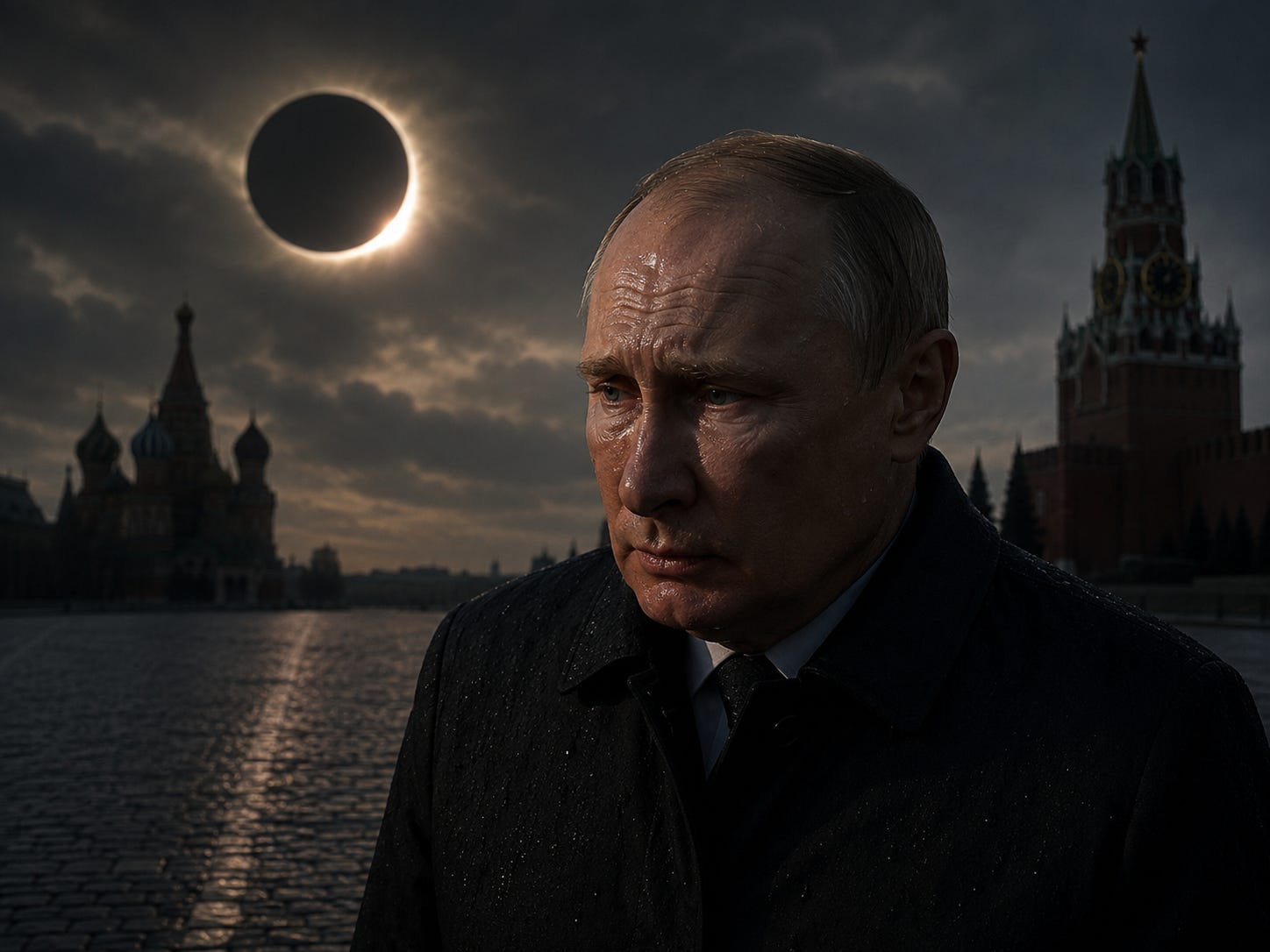
Astrology has almost no standing in conventional political analysis. That low status is understandable. It has no generally accepted causal mechanism, its predictions are often vague and its practitioners can too easily select historical examples after the event.
What follows therefore does not ask readers to accept that planets cause revolutions or determine the fate of rulers. The more modest proposition is that astrology can sometimes function as a form of historical pattern recognition—a symbolic clock whose recurring configurations appear alongside recurring political themes.
The present pattern is remarkable enough to deserve attention.
In February 2026, the slow outer planets Saturn and Neptune began a new 36-year conjunction cycle. Their previous conjunctions repeatedly coincided with fundamental transitions in Russian power. Now, as Russia’s war against Ukraine becomes increasingly costly and self-defeating, two August eclipses place unusually exact pressure on Vladimir Putin’s horoscope.
The symbolism suggests more than a temporary setback. It points toward the possible separation of Putin from Russia—the exposure of a widening divide between the interests of the ruler and the national interests of the country.
Russia’s Saturn–Neptune regime cycle
Astrologers associate Saturn with material structures, authority, hierarchy, discipline and the state. Neptune represents collective ideals, faith, sacrifice, propaganda, illusion and dissolution. Their meeting therefore symbolises the start of a new political structure and its legitimating mythology. The Russian sequence is striking.
1881–82: Tsar Alexander II was assassinated in March 1881, during the approach to the Saturn–Neptune conjunction of 1882. His death ended a reforming phase of the Romanov monarchy and brought the reactionary rule of Alexander III. (EBSCO)
1917: Saturn and Neptune formed an exact conjunction in Leo on 1 August. That year saw the fall of the Romanov monarchy, followed by the Bolshevik seizure of power and the creation of a radically different Russian political order. (Cafe Astrology)
1952–53: Saturn and Neptune made three conjunctions between November 1952 and July 1953. Stalin died on 5 March 1953, opening a succession struggle and a new era that gradually dismantled the most extreme features of his personal dictatorship. (Cafe Astrology)
1989: The planets conjoined three times in Capricorn. The Berlin Wall fell on 9 November, Communist governments collapsed across Eastern Europe and the process culminated in the dissolution of the Soviet Union in December 1991. (Cafe Astrology)
2026: Saturn and Neptune met at 0°45′ Aries on 20 February. This begins another cycle at the start of the zodiac, symbolically combining the dissolution of an exhausted order with the forceful initiation of something new. (Cafe Astrology)
“Dynastic cycle” should be understood here in a broad sense. Russia has passed from Romanov monarchy to Leninist revolution, Stalinist dictatorship, late Soviet rule and Putin’s highly personalised system. These different ideologies each constructed political authority around a dominant sovereign centre, forming a distinct regime that rose and fell with the Saturn-Neptune cycle. At each Saturn–Neptune conjunction, the previous regime lost its aura of permanence.
Putin’s imperial illusion
Putin’s legitimacy has rested on a simple political mythology. He presented himself as the leader who restored order after the instability of the 1990s, recovered Russian strength and protected the country from Western encirclement.
The war against Ukraine was meant to complete that story. Instead, it increasingly threatens to destroy it.
The invasion was founded on a grandiose political illusion—that Ukraine could be compelled to surrender its independent national identity and return to a Russian imperial sphere. The effort to make Russia safer through the subordination of Ukraine has instead produced prolonged war, immense casualties, economic strain, attacks deep inside Russia and growing dependence upon increasingly costly military mobilisation for a war that throws the flower of Russian youth into a horrible meat grinder, 1000 deaths a day.
In Saturn–Neptune astrology, Neptune is the imperial fantasy while Saturn is the accumulating bill. Putin may now face the recurring Russian fate symbolised by this cycle: the ruler who identifies himself with the state eventually discovers that the survival of the state requires liberation from the ruler.
The Leo eclipse
The total solar eclipse on 12 August 2026 occurs at 20° Leo. Totality begins in the north of Russia before crossing Greenland, Iceland and Spain. (NASA Science)
Leo is the traditional sign of sovereign authority, royal display, personal command and the ruler as the visible embodiment of the nation. A solar eclipse in Leo therefore carries obvious symbolism for political leadership: the sovereign light is obscured.
The contact with Putin’s natal horoscope is unusually precise.
Putin’s accepted birth date is 7 October 1952, although his birth time is disputed. The uncertainty means that claims involving his Ascendant, houses or Midheaven must be treated cautiously. The positions of slower planets and the lunar nodal axis, however, are sufficiently stable for this analysis. (Kepler College Library)
The eclipse falls at his natal South Node in Leo. It is about two and a half degrees from his natal Pluto at 22°43′ Leo, within roughly half a degree of a square to his Jupiter at 19°44′ Taurus.
Putin’s Jupiter–Pluto-Node square is seen in astrology as describing the enormous amplification of personal and state power: wealth, ideology, territorial ambition and the conviction that force can overcome ordinary limits. The South Node suggests an established pattern upon which the person repeatedly relies, even after it has become exhausted.
The 12 August solar eclipse falls on the South Lunar Node. In astrological tradition, the South Node carries meanings of depletion, release, karmic consequence and the exhaustion of an established pattern. A North Node eclipse can suggest emergence toward a new future, but a South Node eclipse more often strips energy from what has become overextended or historically spent. Applied to Leo, the sign of sovereign authority, personal rule and the ruler’s identification with the state, this suggests not the rise of a stronger cult of leadership but the weakening of it. In Putin’s case, the image is powerful; the eclipse does not simply darken the sky, it symbolically withdraws vitality from a political style based on personal dominance, imperial prestige and the claim to embody Russia’s destiny. The implication is that an old method of rule is reaching the point of karmic exhaustion.
An eclipse at this point can be interpreted as the depletion of Putin’s habitual method of rule. The image of the invulnerable leader may become impossible to sustain. Pluto’s hidden machinery of coercion is exposed, while the square to Jupiter confronts imperial expansion with material limits.
This does not mean that Putin will be removed on 12 August. Eclipses usually describe periods of exposure and transition rather than single-day events. But the symbolism of a total eclipse beginning over Russian territory and falling directly across Putin’s power complex is difficult to ignore.
The partial lunar eclipse on 27–28 August at 5° Pisces may describe a second stage—the emotional and psychological consequences of what the solar eclipse exposes. This is square Putin’s Moon. (Cafe Astrology)
The war comes home
Astrological symbols acquire political force only where social conditions are already fragile. The political facts need no astrology.
Independent analysis by Mediazona and Meduza estimates that approximately 352,000 Russian men aged 18 to 59 had been killed in the war by the end of 2025. Precise totals remain uncertain, but every serious estimate indicates casualties on a scale capable of leaving deep demographic and social wounds. (Mediazona)
Until recently, much of this cost could be geographically and socially dispersed. Recruitment was concentrated among poorer regions, prisoners, ethnic minorities and men attracted by large payments. Many residents of Moscow and other major cities could experience the war mainly through television.
That insulation is breaking down.
Ukrainian attacks on Russian refineries reduced gasoline production to about 65 per cent of normal seasonal demand. Russia has been forced to restrict exports and import fuel from Belarus, India, Kazakhstan and Morocco. (Reuters)
Drone attacks on Wildberries—the Russian equivalent of Amazon—have damaged or destroyed more than a dozen logistics facilities. The political significance lies not merely in the physical damage. Wildberries is part of the infrastructure of ordinary consumer life as well as military logistics. Burning warehouses and disrupted deliveries demonstrate that the state can no longer keep the war separate from domestic normality. (Reuters)
Russia’s economy contracted in the first quarter of 2026 and the government reduced its official annual growth forecast to 0.4 per cent. (Reuters)
Polling remains difficult to interpret under authoritarian conditions, and nationalist support has not disappeared. Even so, a June Levada survey found that 64 per cent of respondents favoured moving toward peace negotiations, while the proportion believing Russia was moving in the right direction fell to its lowest level since the full-scale invasion. (Russia Matters)
The most dangerous issue may be the possibility of another mass mobilisation. Analysts cited by Reuters argue that Russia is losing soldiers faster than it can readily replace them and that compulsory mobilisation would be politically hazardous. A separate Reuters report noted that taking the remainder of the Donbas may require the very mandatory draft Putin has so far resisted. (Reuters)
Fuel scarcity creates frustration. Conscription creates existential fear.
The potentially revolutionary combination is therefore:
mass death, visible state vulnerability, disruption of ordinary life and the threat that the government may demand still more sons, husbands and fathers.
From private grievance to public recognition
Hardship alone rarely destroys an authoritarian government. It may instead intensify nationalism, particularly when the regime persuades people that an external enemy is responsible.
A political break occurs when attribution changes.
The Kremlin’s message is:
Russia is suffering because the West seeks to destroy it.
The counter-narrative is:
Russia is suffering because Putin has trapped it in a futile war that serves his political survival rather than the country’s security.
Fuel queues could play a distinctive role in this shift. Military deaths are scattered across families and regions. Fuel shortages are simultaneous, visible and economically contagious. They affect transport, agriculture, food prices, employment and the physical circulation of daily life.
They can therefore act as a synchronising grievance, allowing millions of people to recognise that their apparently private frustrations are widely shared.
The threat of mobilisation could then become the detonator. The 2022 call-up already produced an exodus, demonstrations and unusually prominent protests by women, including serious unrest in Dagestan. (Reuters)
Russia’s coercive apparatus remains formidable. Opposition figures are imprisoned, exiled or excluded, independent media have been suppressed and the security services remain closely tied to the regime. (Freedom House)
A spontaneous nationwide revolution is therefore far from inevitable. More plausible beginnings would include draft resistance, local fuel protests, labour disruption, regional disobedience, military-family activism and growing criticism from within the governing elite.
But authoritarian systems often appear stable until formerly isolated grievances suddenly become connected. An uprising becomes possible when the public recognises its shared dissatisfaction and sections of the elite begin to doubt that repression can preserve the system.
Separating Putin from Russia
The deeper symbolism of the eclipse is the potential separation of Putin from Russia itself.
Putin has spent decades merging his personal authority with Russian identity. To oppose him is portrayed as opposing Russia. To question the war is presented as betrayal. His continued rule depends upon the proposition that there is no viable Russia beyond Putinism.
The eclipse suggests the possible reversal of that identification.
The political discovery would be that Putin is no longer Russia’s protector but the principal obstacle to its security, prosperity and normal development. His need to avoid defeat may require endless war, while Russia’s national interest requires peace.
Different groups could reach this conclusion for different reasons.
Military families want an end to death and mobilisation. Businesses want investment, functioning credit markets, access to technology and predictable trade. Regional authorities want fuel and public services. Younger Russians want mobility and cultural connection. Security elites may eventually decide that preserving the ruler is endangering the state.
Putin would then become isolated before he was formally removed.
This is how a regime change could begin—not necessarily with crowds immediately storming the Kremlin, but with the gradual collapse of the belief that Putin’s political survival and Russia’s survival are the same thing.
Rejoining the West
The alternative could be framed not as capitulation but as Russian national restoration.
Russia does not need to abandon its sovereignty, history or distinctive culture. It needs to abandon the proposition that permanent confrontation with Europe is the foundation of national greatness.
“Rejoining the West” would initially mean ending the war, respecting Ukraine’s independence and restoring normal diplomatic, economic, scientific and cultural relations with Europe and North America and other advanced nations. Sanctions relief could follow a credible settlement. Trade, investment, technology exchange and freedom of movement could gradually return.
The patriotic argument would be simple:
Russia’s stability and prosperity depend upon peace, internal reconstruction and renewed cooperation with Europe—not the permanent militarisation of society in pursuit of an unattainable empire.
The most damaging illusion of Putinism is that reconciliation would diminish Russia. In reality, the war is consuming Russian lives, weakening its economy, exposing its infrastructure and narrowing its international options.
Putin sought to reverse the collapse of Soviet power. His war may instead repeat the pattern by placing an exhausted ideology against unbearable material reality.
What astrology can and cannot say
Astrology cannot tell us that Putin will fall in August. It cannot establish which general, oligarch, regional leader or popular movement might precipitate a crisis. Nor can it replace military analysis, economics, polling or the study of Russian institutions.
It can offer a symbolic chronology.
That chronology says that Russia has repeatedly undergone fundamental changes of ruler and regime at Saturn–Neptune conjunctions. The present conjunction occurs as Putin’s imperial mythology encounters its material limits. The August solar eclipse then falls with extraordinary precision across the natal configuration associated with his power, expansion and political destiny.
The political environment supplies the mundane mechanism: staggering war deaths, fuel shortages, attacks on domestic logistics, economic stagnation and fear of compulsory mobilisation.
The astrological message is therefore not that an eclipse removes a dictator. It is that the eclipse may mark the moment when hidden fragility becomes visible and separate grievances begin to acquire a common political meaning.
Putin’s undoing may lie in the very project intended to secure his historical greatness. His confrontation with Ukraine has become grandiose in conception, futile in execution and destructive of Russia’s own long-term interests.
The question raised by August is larger than whether one ruler falls.
It is whether Russia can begin to imagine itself beyond him.
The Saturn–Neptune cycle may be closing the Putin era. The eclipse may reveal that Russia’s future depends upon allowing Putin’s personal sun to set.
Very interesting correlation, Robert! I can picture RasszPutin singing, " Only Fools' Russian" in an Elvis costume.