Cutting Emissions and Climate Breakdown
Planetary Arithmetic of UN Climate Crisis Vote

A friend recently commented that the UN’s recent ‘climate crisis vote’ calling for decarbonisation of the world economy as proposed by the Pacific Island Nation of Vanuatu shows political momentum is growing for carbon action, as reported in this Guardian article. Unfortunately the report shows nothing of the sort. The clamour of groupthink among elites does not constitute political momentum.
The world has polarised into rival camps on energy policy. The political backlash against renewable energy is growing. Momentum against fossil fuels is imaginary.
The ‘Vanuatu Bubble’ of policy groupthink that produced this UN vote against fossil fuels is only sustained by a determined refusal to even discuss conflicting evidence. Someone circulated a claim that “Vanuatu will be wiped from the map unless we stop burning fossil fuels.” This is vacuous disinformation at many levels. Even if all combustion ended today, sea level would continue to rise due to the committed warming from past emissions. Cutting new emissions is marginal to sea level rise. And Vanuatu’s land area is 99% volcanic mountains, unlike the low coral atolls which the author of this comment seems to have assumed are typical of all Pacific Islands.
The conspiracy theories on both sides of the energy debate are equally absurd. Deniers insist climate scientists are only in it for the money. Decarbonisers similarly contend that the groundswell of hostility toward renewable energy is entirely based on corporate misinformation.
It would be great to have a serious debate on whether banning fossil fuels can actually constitute “action against the climate crisis”, as the UN friends of Vanuatu maintain. But in any case, the likelihood and feasibility of rapid carbon action at climate scale is nil, in the absence of popular acceptance of economic collapse. This is why a policy switch is needed to focus on action to rebrighten the planet as the only practical interim transition strategy to a stable climate.
The most absurd line in the Guardian article was “The recognition by states that they have a legal responsibility to address climate breakdown by cutting their greenhouse gas emissions, including tackling fossil fuels, could prove a boost for climate diplomacy and litigation, according to experts.” The absurdity here is that cutting emissions does not address climate breakdown, but instead actively prevents the only action that could slow breakdown, ie restoring albedo.
I got some pushback on this claim, so it is important to explain it scientifically. My view on the relationship between cutting emissions and climate breakdown challenges the consensus so I appreciate debate over it.
How can cutting emissions “address climate breakdown” as The Guardian puts it, a view shared by the whole carbon action consensus?
It can’t. My approach is to analyse this scientific claim against planetary arithmetic. Warming is caused by the approx. 2.5 trillion tonnes (tt) of CO2 that industrious humans have emitted into the atmosphere, plus other greenhouse gases such as methane that are measured as CO2 equivalent (CO2e). A bit less than half of that CO2 total, about 1.18 tt, is still in the air, plus other GHGs, while the rest is mostly in biomass or dissolved in the ocean. This total is increasing by annual emissions of 0.06 tt CO2e per year (60 gigatonnes) less natural removals.
Considered in practical terms, a highly effective global decarbonisation program might reduce that gross rate of addition by ten billion tonnes a year, net 20%, to 0.05 tt in twenty five years, or even 0.04 tt. Of course far more aggressive results are discussed, including net zero by 2050, a 100% decline in net combustion, but economic and political realities make such suggestions unlikely, barring collapse of the world economy, especially at a time when the annual rate of emissions is increasing.
So lets consider two scenarios over the 25 years to 2050, with annual emissions of 40 and 50 Gt CO2e/y, cutting world emissions by 20 and 10 Gt each year. This is just a simple first approximation model, not a gradual change, and just for illustration, not for advocacy. The IPCC has accepted analysis that says natural removal leaves 68% of CO2 still airborne after 10 years and 57% after 25 years, although finding these exact numbers is a challenge. I have just used 68% as a rough guide. I have done these calculations fresh so they may have mistakes, but I expect they are close to the mark. And for context, far from a 10 Gt cut in annual emissions, even the Paris Accord agreed that world emissions should actually keep rising until 2030 even in the unlikely event that all national pledges were met, illustrating how difficult such an economic transformation would be.
In the first scenario, assuming emissions averaging 40 Gt/y from now, the rough human-caused 2050 atmospheric CO2 total would be 1.18tt + (0.04 x 25 x 0.68) = 1.86tt. That means the current 1.18 trillion tonnes plus the remaining 68% of the 40 gigatonnes each year over 25 years.
That is 24% more excess CO2 in the air than today, causing a 24% increase in radiative forcing, the integrated measure of global warming, as a first approximation of additional climate forcing, but leaving out feedback processes like the loss of clouds and ice and trees which would actually make it much worse.
In the second scenario, assuming emissions averaging 50 Gt/y, the rough 2050 total would be 1.18 + (0.05 x 25 x 0.68 ) = 2.03tt. That is 35% more than today.
On these figures, each 10 Gt/y added or removed makes a difference of roughly 11% between the cumulative GHG scenarios. A rule of thumb might be that removing one gigatonne of CO2 per year improves the climate by 1%. That is materially significant, and the calculation could be refined, but the bottom line is that in the short run even a large GHG removal is marginal to the vast forces producing climate breakdown. And of course, just offshoring the emissions to China does not count, since in fact that politically accepted accounting trick actually makes warming worse.
My UK colleague Dr Robert Chris has produced an excellent simple climate model that we sometimes call What The Fuck! His World Temperature Forecaster model lets anyone put in scenarios for emission reduction, carbon dioxide removal and sunlight reflection to see the future temperature impact based on widely accepted calculations. I put this 10 Gt annual effort into the model and found it would cut 2050 temperature rise by 0.11°C, from 2.08 to 1.97°C, while cutting radiative forcing by 0.25 w/m2. That is a small result for a large effort. Actually it is worse than nothing, in view of the resulting failure to take other steps that would actually stabilise the climate. That means cutting emissions is not a climate policy.
The problem is far worse than the mere smallness of cutting of the 2050 temperature rise by 0.1°C, because of the economic problems of opportunity cost and crowding out.
The opportunity cost is that achieving a ten gigatonne GHG reduction is expensive, and will exclude far more effective cooling methods, notably Sunlight Reflection Methods (SRM). This exclusion is due to a perverse argument known as moral hazard, which insists subsidies for energy reform are far more important than actually cooling the planet as a climate policy. Against this argument, the UK Royal Society estimated in its 2009 Geoengineering Review (table 3.6) that SRM is one thousand times better value for money than emission reduction as a cooling strategy. That is a big difference, and a big opportunity cost. When governments universally choose to fund something that has a 1000 times worse return on investment than a possible alternative, it is important to ask why. Unfortunately, in this case, the answers are stupidity and herd mentality. That is bad.
The opportunity cost problem is closely related to the economics of crowding out, which usually means government spending creates stagnation by removing room for private investment. Here I am using crowding out to describe how the real politics of climate policy require that renewable advocates must demonise SRM, crowding it out in order to justify their false claim that energy reform is a climate strategy. All the oxygen is sucked out of SRM advocacy, crowding it out of public view and investability, by the vast sums devoted to decarbonising the economy, which the figures above show has only a small net climate impact compared to doing nothing.
But in fact the problem is even worse again because of the problem of tipping points. Considered against the scale of Earth System risks, the 0.1 degrees of cooling over 25 years from each ten gigatonnes of net annual emission reduction is just noise that will be totally drowned out by the Earth System warming signal. The only action that can materially slow major planetary tipping points in coming decades is planetary rebrightening with SRM. Given that a number of tipping points such as loss of forests, ocean biomass, permafrost and polar methane have the effect of turning carbon sinks into sources, the monomaniacal focus on emissions will be totally swamped by GHGs from these feedbacks unless we take action to rebrighten the planet. The key climate priority should be reversing the 2% darkening this century which is causing more warming than the greenhouse effect from new emissions.
But in fact the problem is even worse again because of political polarisation. Aggressive advocacy of a highly contested carbon plan that on the above figures might slow warming by 0.1°C by 2050 has generated massive backlash, notably the Trump shutdown of climate research. My interpretation is that this shutdown is a direct response to climate scientists falsely extrapolating from their science to the ideological campaign to stop fossil fuel use. This has led to capitalist industries becoming hesitant to engage seriously on climate except as PR, when they should be leading public advocacy for the commercial benefits of a cooler planet. A focus on decarbonisation excludes essential constituencies of support.
Cutting emissions by 10 gigatonnes of CO2e per year would require massive effort, and would barely slow the worsening of the climate. The difficult politics, together with the analyses that suggest renewables are additional rather than replacive, exacerbates the primary risk that decarbonisation simply will not happen, leaving us with no defence against the wrath of Gaia. In climate terms emission reduction is a nice to have, not an immediate critical path element.
I continue to support emission reduction, but this can mainly be accelerated by CDR after the pipe, not by preventing combustion before the pipe. Decarbonisation should be driven mainly by market and environmental concerns, not climate.
This UN climate crisis vote, like the recent anti fossil fuel conference, is a diversion into a fool’s paradise. SRM is the main game for climate stability.
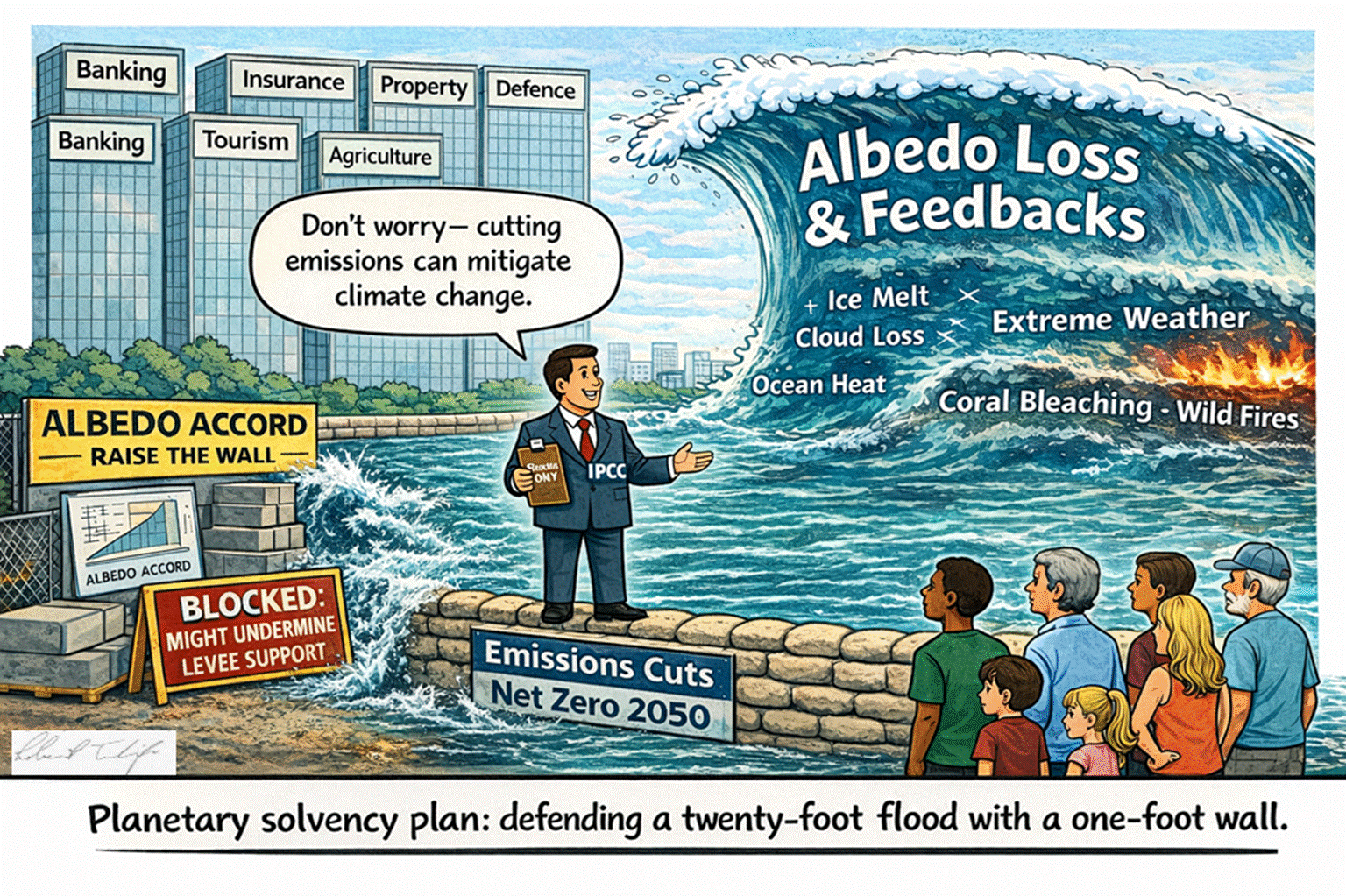
I don’t agree on cutting emissions. My view is that large scale ocean based algae production will be needed as the primary carbon strategy, at a scale larger than total world emissions, and this will enable emissions to continue while the CO2 level declines, alongside cooling from rebrightening the planet with restored albedo.
Just a note..the ipcc fellow in the cartoon should be saying "only cutting emissions". We all agree on cutting emissions. The ipcc fellow is implying only cutting emissions is the fix which is bollocks.